01
Prepare for the stay
Give booked guests a clear arrival-planning page and collect the details your team needs.
Knight Ops Guest Operations
Give booked guests one clear way to prepare for their stay, and give staff a shared view of arrival details, service requests and the next action.
For owner-led villas, boutique accommodation and small property-management teams.
01
Give booked guests a clear arrival-planning page and collect the details your team needs.
02
Let guests request agreed services such as transport, groceries or a chef, with the information needed to arrange them.
03
Give staff a place to see requests, take the next action and keep the current status visible.
04
Make unresolved requests and failed steps visible to the person responsible for following up.
We scope the channels, services and integrations for your operation. Existing reservation software can stay where it works well. Direct-booking improvements are a separate scope when there is a clear reason to add them.
This is the public stay planner at Sweet Dreams, a business Frank owns and operates. The walkthrough below separates the visible guest journey from the work staff still handle.
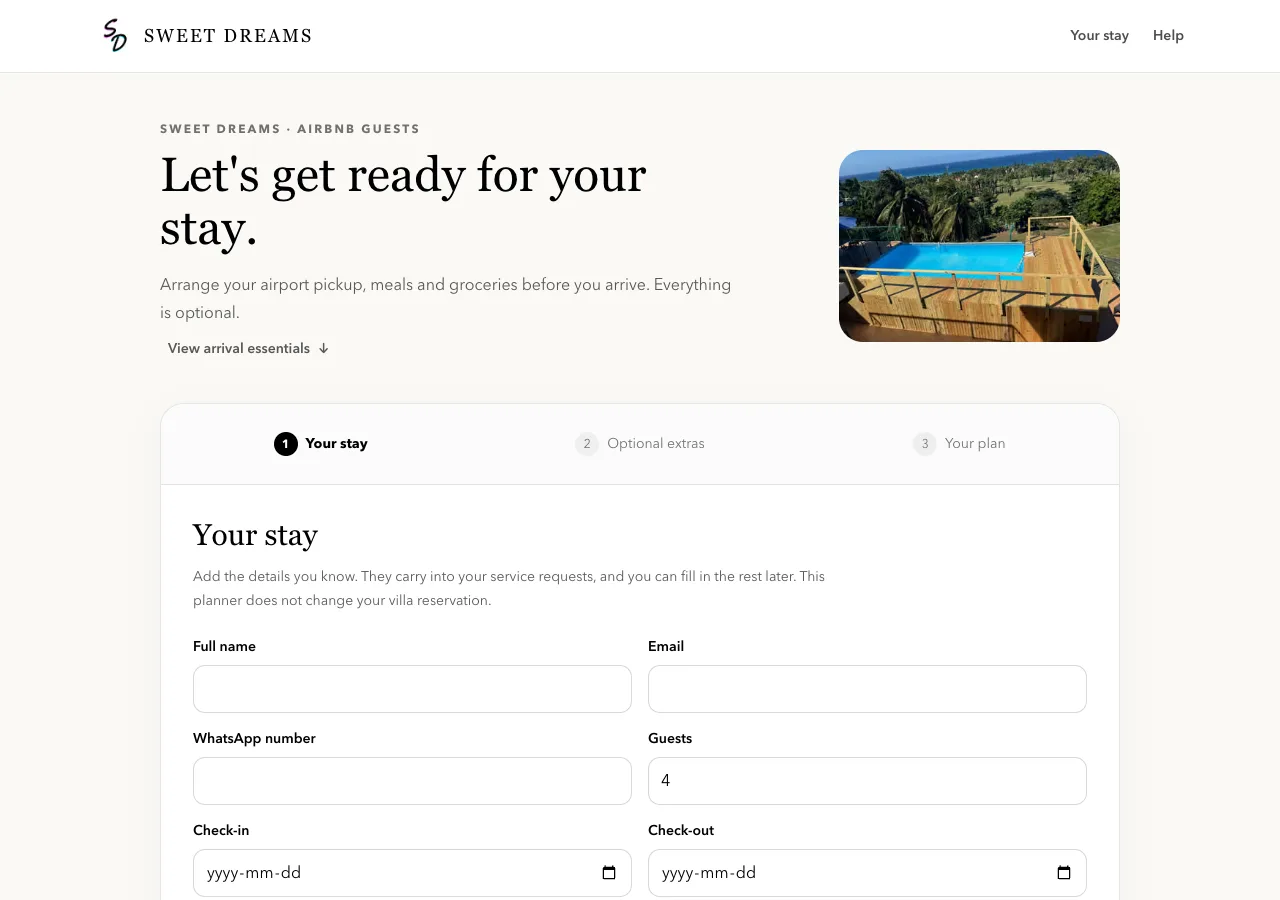
Guests arriving through Airbnb or Vrbo receive a dedicated planning link. Sharing that welcome link is currently a manual step. The planner does not change their accommodation reservation.
The guest enters stay information and can move to extras such as transport, meals and groceries. Service forms reuse relevant details. Each request has its own submission and status; choosing an extra does not automatically confirm availability.
Separate staff tools show inquiries, booking and payment reviews, arrivals and service work. People remain responsible for accepting requests and coordinating delivery. Balance and pre-arrival follow-up are still manual in the current operation.
Useful measures include time spent handling each stay, missing arrival details, unresolved requests and owner interventions. We establish your baseline during the Blueprint. This example does not claim a measured saving or revenue increase.
We agree a branded guest entry point, the information collected, a defined set of service requests, staff roles, notifications and exception handling. Training, operating instructions and a stabilization period are included in the written scope.
Complex data migration, additional properties, accounting changes and reservation-platform replacement are quoted separately.
A clear first purchase, an agreed installation, and support that matches what you need.
01 · Operations Blueprint
$1,500 USD
Map one workflow, measure the repeated work, and decide what to keep, connect or build. Leave with a written plan and implementation scope.
Usually one week once people and information are available.
Discuss operations blueprint →02 · Workflow Installation
$12,000–$18,000 USD
One complete operational journey, installed and tested with your team. Includes agreed integrations, training, operating instructions and launch stabilization.
A four-to-six-week target, confirmed after scoping.
Discuss workflow installation →03 · Ongoing service
from $600 USD/month
Choose technical care or a managed improvement plan. Coverage, response windows, provider costs and the allowance for changes are agreed before you start.
Starts after installation or assessment of an existing system.
Discuss ongoing service →The Blueprint fee is credited toward an implementation booked within 30 days. The installation range covers a substantial standard workflow. Smaller, clearly scoped improvements are quoted directly; broader systems are planned in phases. Provider costs and applicable taxes are stated separately. When the scope is already clear, we can propose the installation directly.
We will talk through what happened, where the work got stuck and whether a focused installation would help.